
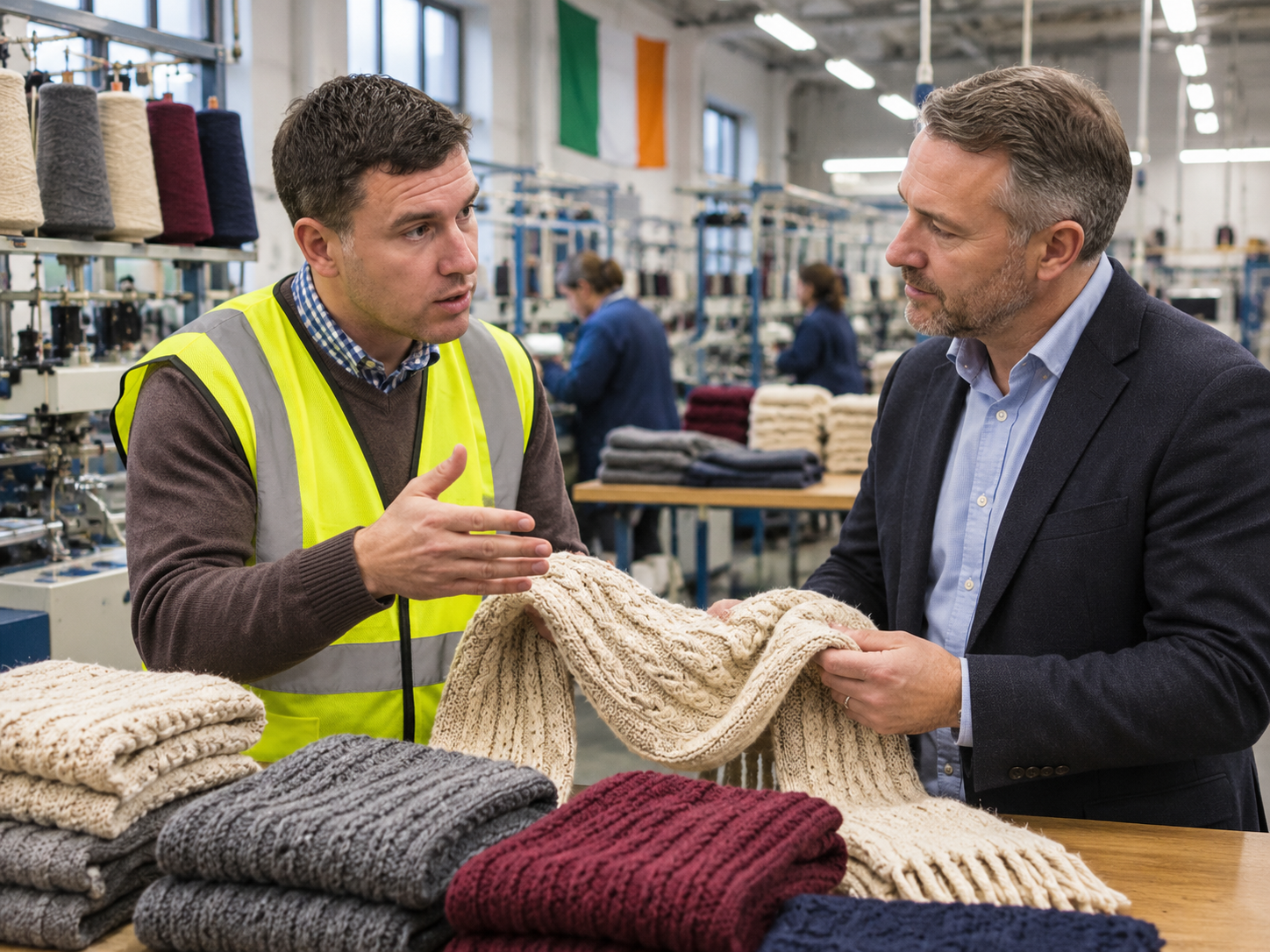
Ireland is often treated as an extension of the UK market: same language, similar shops, a short ferry crossing away. For anyone trading with Ireland that assumption is now expensive. Ireland is a full member of the European Union and the eurozone, and since Brexit the Irish Sea has been an EU customs border. The rules on product safety, labelling, VAT and customs that apply in Dublin are the rules of Paris and Berlin, not London.
In short: Ireland is an English-speaking member of the EU and the eurozone, so EU rules on customs, CE marking, product safety (GPSR), food labelling and VAT apply. Goods from other EU countries enter without customs. Goods from Great Britain and the rest of the world need customs declarations and import VAT, a UKCA mark alone is not accepted, and non-EU sellers of consumer products need an EU-based responsible person.
This guide covers both sides: buying from Irish suppliers, and selling into Ireland from the UK, the US or Asia.
Ireland at a glance
| Indicator | Figure |
|---|---|
| Population | 5.53 million (April 2026), up 1.2% in a year; Dublin 1.6 million (CSO) |
| Economy | Domestic economy (modified domestic demand) grew 4.7% in 2025; headline GDP grew 8%, inflated by multinational activity (CSO) |
| Goods exports | €260.3 billion in 2025, a record; medical and pharmaceutical products 53% (CSO) |
| Goods imports | €144 billion in 2025; top sources the US (15.7%), Great Britain (11.3%) and Germany (11.1%) (CSO) |
| Food and drink exports | €19 billion in 2025, a record; €7.1 billion to other EU countries (Bord Bia) |
| Businesses | 401,359 active enterprises (2023); 99.8% are SMEs, employing two-thirds of the workforce (CSO) |
| Currency and VAT | Euro; standard VAT rate 23% |
Ireland is really two economies: a large US-owned pharmaceutical and technology sector, which inflates GDP, and a domestic base made up almost entirely of small firms. Most buyers and suppliers you will deal with are in the second group, so use modified domestic demand, not GDP, to size the market.
Ireland in the EU: what it means for your trading terms
Ireland joined the then European Economic Community in 1973 and has used the euro since it was introduced. For anyone trading with Ireland, membership shapes almost everything:
- No customs between Ireland and other EU countries. Goods from Germany, France or Poland move into Ireland without declarations or duty, as part of a single market of around 450 million consumers.
- One external tariff. Goods from outside the EU, including Great Britain, pay the EU’s common customs tariff unless a trade agreement gives a lower rate.
- EU trade agreements apply. Irish importers benefit from the EU’s agreements with countries such as Japan, South Korea, Canada and Vietnam, provided the goods meet the rules of origin.
- EU law applies directly. Product safety, CE marking, food labelling, VAT and late payment rules are the same in Ireland as across the EU.
The practical result: for an EU supplier, selling to Ireland is like selling to any other member state. For a UK, US or Asian supplier, Ireland is an EU import market and should be treated as one.
If you trade across Europe, our guides to trading with Italy, trading with France and trading with Poland cover the same EU rules from those markets’ side.
Sourcing from Ireland: what SMEs can buy
Ireland is not a low-cost manufacturing country, and buyers should not approach it as one. Labour, energy and property costs are high. What Ireland offers is quality, traceability, reliable compliance with EU standards and a strong reputation in a few specific categories. Companies supported by Enterprise Ireland, the state agency for Irish-owned exporters, exported a record €38.9 billion in 2025, and that indigenous base is where most small and medium buyers will find their suppliers.
The main categories for SME buyers are:
- Dairy: butter, cheese and dairy ingredients from grass-fed herds; exports reached €7.3 billion in 2025.
- Meat: beef, lamb, pork and value-added meat products; over €5 billion.
- Prepared foods: bakery, confectionery, ready meals and sauces; €3.6 billion.
- Drinks: whiskey, gin, cream liqueurs and craft beer. Whiskey alone was worth about €930 million, despite a 5% fall.
- Seafood: shellfish, salmon and whitefish; €635 million.
- Engineering: agricultural machinery, precision parts, fabricated metalwork and components for medtech and electronics.
- Construction products: modular building systems, insulation, precast concrete and timber frame.
- Textiles and crafts: Aran knitwear, Donegal tweed, linen, crystal, pottery and homewares.
- Cosmetics: natural and seaweed-based skincare from small brands.
Smaller Irish producers are often excellent, but not always set up for large or repeat export orders. Confirm capacity, lead times and batch consistency rather than assuming them, particularly for knitwear, craft drinks and artisan food.
Engineered parts need the same care. One of our clients sourced moulded outer covers for medical tables from a facility in Ireland and asked us for a during-production inspection, because the part was critical to the final assembly. Our inspector found glue residue on the moulds, which left the covers loose in their sockets, so the finished tables would not have conformed. The client’s QA team raised a non-conformance report that day, production was stopped, every part was checked and corrected, and the machinery was recalibrated. One day was lost, and the defect never reached the assembly line.
Ireland’s competitive advantages as a sourcing base
Ireland’s advantages are less about price and more about how easy it is to do business. Contracts, specifications and correspondence are in English, the common law system feels familiar to UK and US buyers, and goods bought in Ireland move freely across the EU in euro.
For food, grass-based farming, national quality schemes and Bord Bia’s Origin Green sustainability programme give Irish produce a strong position with retailers and food service buyers. Ireland also sits between North America and continental Europe, with direct ferry routes to France and Spain as well as the UK, and decades of foreign investment have built a skilled engineering and life sciences workforce.
The trade-offs are price, scale and logistics. Ireland is an island at the edge of Europe, so freight costs and transit times to the continent matter, and many suppliers are small. Build those into your comparison with suppliers elsewhere in the EU.
Selling and exporting goods to Ireland
Ireland is a small market, but a wealthy and growing one. For an overseas supplier, the main routes in are:
- An Irish distributor or wholesaler. The usual route for consumer goods, food and building products. One distributor often covers the whole island, so choose carefully and agree territory and stockholding in writing.
- Direct sales to retailers and buyers. Possible for larger accounts, but expect buyers to want a local or EU-based contact.
- E-commerce. An important channel, but only if your prices include all duties and taxes.
- Public tenders. Irish public bodies buy through EU-compliant tenders published on eTenders, and must pay within 30 days.
Market size cuts both ways. Order volumes are smaller than in the UK, Germany or France, and a buyer may want a mixed load or a part-pallet rather than full containers. On the other hand, a good relationship with two or three key accounts or one strong distributor can give you national coverage.
Why Ireland is not the same as the UK
Many companies still serve Ireland from a UK office, a UK warehouse and a UK price list. Before 2021 that worked. Today Ireland and Great Britain are in different customs territories with different product laws, and Irish buyers have changed how they buy.
Different trading laws
| Area | Ireland (EU) | Great Britain |
|---|---|---|
| Customs | EU customs union; no declarations from other EU states | Separate customs territory; declarations needed both ways between GB and Ireland |
| Tariffs | EU common customs tariff and EU trade agreements | UK Global Tariff and UK trade agreements |
| Product marking | CE marking; a UKCA mark alone is not accepted | UKCA, with CE still accepted for most products |
| General product safety | EU GPSR (since 13 Dec 2024), including an EU-based responsible person | General Product Safety Regulations 2005, now under review |
| Low-value parcels | €3 customs duty per item category on parcels of €150 or less from outside the EU (since 1 July 2026) | Separate UK rules |
| VAT | 23% standard rate; EU OSS and IOSS schemes | 20% standard rate; UK VAT system |
| Currency | Euro | Sterling |
Northern Ireland is a special case. Under the Windsor Framework, EU product rules including the GPSR apply there, so a business selling across the whole island needs to meet EU requirements north and south.
Seed potatoes show how far apart the two markets can be. Before Brexit, Ireland imported around 4,000 tonnes of seed potatoes a year from Britain, and Scotland supplied about 60% of the certified seed planted in Ireland. On 1 January 2021 that trade stopped, because the EU would not accept UK plant health rules as equivalent. No paperwork or pricing could fix it. British suppliers lost the Irish market overnight, Irish growers faced tighter supply and higher seed prices, and the Irish government backed more home-grown seed production. It is not expected to reopen until a UK–EU plant and food agreement takes effect, targeted for mid-2027.
Different buyer behaviour
Law is only half of it. Irish buyers also behave differently from UK buyers, and treating Ireland as a UK region is one of the quickest ways to lose an account.
First, they are moving supply chains to the EU. For decades many Irish wholesalers and retailers bought through UK distributors. Since Brexit, customs paperwork, duty and delays have pushed many of them to find suppliers in continental Europe. Great Britain is still Ireland’s second-largest source of imports, but buyers now compare a UK supplier’s landed cost against an EU supplier with no customs at all.
Consumers have done the same. Irish shoppers hit with customs charges and delays on UK orders moved to Irish and EU websites.
Irish buyers also expect euro pricing and a clear landed cost. A sterling price list with “duties and VAT extra” puts the risk on the buyer, so quote in euro, on DAP or DDP terms where you can, and spell out the customs position.
Finally, relationships are personal and local. Ireland is a small business community where buyers know each other and reputations travel, so visits, reliable follow-up and a named contact matter more than a polished account-management process. Buyers also notice when Ireland is an afterthought: a website that ships to “UK and Ireland” at UK prices, packaging that ignores EU requirements, or a customer service line that cannot answer an Irish VAT question.
There are similarities that help: the same language, common law contract principles and a familiar retail landscape. Use them, but do not mistake them for the same market.
Customs and product compliance
If your goods are made or held outside the EU, including in Great Britain, plan for:
- Customs declarations on entry to Ireland, with the correct commodity code and an EORI number for the importer.
- Rules of origin. Goods made in the UK can enter duty-free under the EU–UK Trade and Cooperation Agreement, but only if they meet its origin rules. Goods made in China and held in a UK warehouse do not qualify, and pay EU duty.
- Import VAT at the Irish rate when the goods enter, unless postponed accounting or IOSS applies.
- Sanitary and phytosanitary checks for food, plants and animal products from outside the EU.
On the product side, the rules are EU rules:
- CE marking and an EU declaration of conformity for products such as electrical goods, toys, machinery and personal protective equipment.
- EU food labelling, including allergen information and an EU food business operator’s name and address.
- REACH, RoHS, WEEE and packaging rules where they apply to the product.
GPSR and the EU responsible person
The EU General Product Safety Regulation applies to almost all non-food consumer products sold in Ireland. One requirement catches many non-EU sellers: a covered product cannot be placed on the EU market unless there is an economic operator established in the EU who is responsible for its compliance. That operator’s name and contact details must appear on the product, its packaging or an accompanying document, and marketplaces such as Amazon will ask for them.
The rule caught many small British businesses unprepared. In February 2025, The Guardian reported that a family textile business on the Isle of Skye had stopped taking online orders from the EU and Northern Ireland when GPSR came in. It had to appoint an EU representative, at several hundred pounds a year, before it could reopen. A Bedfordshire firm selling bike lubricants, with up to a fifth of its business in the EU, had to pause sales for the same reason.
For a UK, US or Chinese brand with no EU company, the usual answer is to appoint an EU-based responsible person or authorised representative. TCI China, from its office at Rosemount Business Park in Blanchardstown, Dublin 11, provides an Irish-based EU office address and responsible-person service for GPSR, acting as the EU contact for market surveillance authorities and supporting recalls if they are needed. It does not replace your own product testing or safety documentation, but it does close the gap that stops many non-EU sellers listing in Ireland at all.
Payment terms and pricing
The legal default for Irish B2B invoices is 30 days unless agreed otherwise, but in practice many buyers pay later: Allianz Trade puts average payment times in Ireland at around 50 days, and longer for SMEs. Terms beyond 60 days must be expressly agreed, and overdue invoices carry statutory interest at 8% above the ECB reference rate. With a new buyer, use credit insurance or a deposit until they have a payment record.
Managing quality and commercial risk
Whether you are buying from Ireland or shipping into it, the goods still need checking. Two situations matter most:
- Buying from Irish suppliers. Check the first production run against the approved sample and specification, especially with small producers.
- Goods arriving into Ireland. Importers shipping from Asia, the UK or the US into Irish warehouses often have no one on the ground. An inbound inspection confirms quantities, condition, labelling and packaging before the goods go to customers, and gives you evidence for a claim against the supplier or carrier.
One case shows why. A client had fleece tops delivered into a warehouse in Ireland and started receiving customer complaints that one sleeve was longer than the other. Our inspector carried out an AQL random inspection at General Inspection Level II across the stock and found the sleeve defects were well beyond the acceptable limit, so the batch failed. The client pulled the whole batch from sale to protect its reputation, then used our report to make a claim against the supplier, which gave a full refund.
Goodada, a European-owned independent inspection company founded in 2011, carries out quality control inspections and factory audits in Ireland, including supplier audits, pre-shipment inspections, container loading checks and inspections of delivered goods in Irish warehouses, in Dublin, Cork, Galway, Limerick, Waterford and Northern Ireland. Our reports include photographs and a clear list of what was found, so you can decide whether to accept, rework or claim.
Practical checklist before trading with Ireland
- Decide whether you are selling from inside or outside the EU, and plan customs, origin and VAT accordingly.
- Check CE marking, labels and packaging against EU rules.
- Appoint an EU-based responsible person under GPSR if you have no EU company.
- Quote in euro with clear Incoterms, ideally DAP or DDP for smaller buyers.
- Agree territory and responsibilities with distributors in writing.
- Arrange an inspection before shipment or on arrival, so problems are found before your customers find them.
If your goods are being made by an Irish supplier or are arriving into an Irish warehouse, tell us where they are and when they will be ready, and we will suggest the right check. If you sell consumer products into Ireland from outside the EU, TCI China can act as your EU-based responsible person under GPSR from its Dublin office.
Trading with Ireland – About the Author
Aidan Conaty, ACMA, GCMA, MBA, is the founder of TCI China and Goodada.com. He has worked in international trade and sourcing for more than 20 years, helping companies check suppliers, manage production and inspect goods before and after shipment. You can contact Aidan at aidan@goodada.com or on WhatsApp.
Frequently asked questions on trading with Ireland
Is Ireland part of the UK?
No. The Republic of Ireland is an independent country and a member of the European Union and the eurozone. Northern Ireland is part of the UK, but under the Windsor Framework many EU product rules apply there too.
Do UK goods pay duty in Ireland?
Goods that meet the origin rules of the EU–UK Trade and Cooperation Agreement enter duty-free, but they still need customs declarations and import VAT. Goods made elsewhere and shipped through the UK pay EU duty.
Do I need an EU responsible person to sell in Ireland?
If you sell non-food consumer products and have no company in the EU, you generally need an EU-based economic operator responsible for compliance under the GPSR, and their details must be shown on the product or its packaging.
Do I pay VAT on goods bought from the UK?
Yes. Goods from Great Britain are imports into the EU, so Irish import VAT (23% standard rate) is due on entry, along with any customs duty. VAT-registered businesses can usually account for it through postponed accounting rather than paying at the border.
What is the EU €3 parcel duty?
Since 1 July 2026, parcels worth €150 or less sent to EU consumers from outside the EU, including Great Britain, pay a flat €3 customs duty per item category. It is a temporary measure, due to run until 1 July 2028 while the EU’s wider customs reform is put in place.
Official sources and useful links
- Central Statistics Office (CSO) – population, trade and business statistics
- Revenue: customs and importing – Irish customs, VAT and EORI
- Bord Bia – Irish food, drink and horticulture
- Enterprise Ireland – Irish-owned exporters and suppliers
- Competition and Consumer Protection Commission: product safety – GPSR enforcement in Ireland
- EU Access2Markets – EU tariffs, rules of origin and trade agreements
- eTenders – Irish public procurement
- Goodada Ireland inspections