
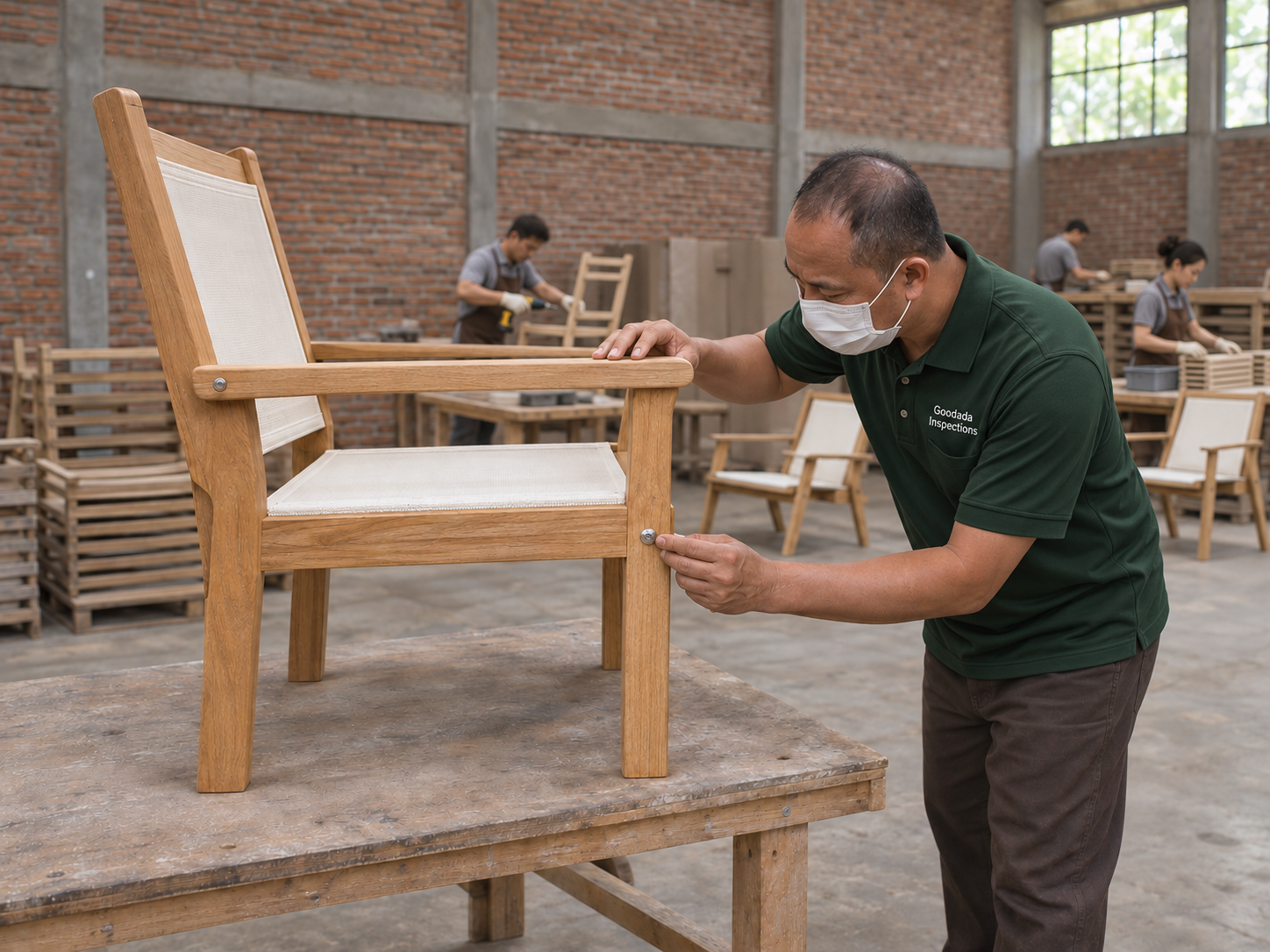
7 Outdoor Furniture Inspection Tips Before You Ship – If you’re buying garden furniture for the season ahead, ask the factory to leave time for an inspection before the goods are loaded. A patio chair can look fine in the supplier’s photos and still wobble when you put it together. By the time the first customer tells you about it, you may have a warehouse full of the same chairs and very little time to do anything about them.
For an outdoor furniture inspection, we check samples from the order against the buyer’s specifications. The checks depend on what you’re buying. On a folding chair, I’d want to see how the lock works. On a flat-pack dining set, I’d want the inspector to build the table and chairs from the cartons that will go to customers. Here are seven things I’d agree with the factory before the visit.
1. Tell the factory what you expect
Start with the purchase order, product drawings, and an approved reference sample or clearly identified photos. Include dimensions and tolerances, frame materials and thickness, finish and colour references, hardware, cushion specifications, and packaging requirements. Record the latest revision and flag any differences between the approved sample and the written specification.
Take a powder-coated aluminium chair. Give the inspector the colour reference and any coating checks you’ve agreed with the supplier. If it’s a flat-pack table, send the assembly instructions and hardware list as well. If a tabletop must sit flat within a certain tolerance, put the figure in writing. That gives the inspector something to measure and the factory something it can put right.
2. Assemble furniture from production cartons
I’d ask the inspector to pick cartons from the order and use the parts and instructions inside. The factory may have a chair already assembled in the showroom. Keep that as a reference and open a few cartons from the actual order. That’s where you’ll find out if the bolts fit and whether the customer has everything they need to assemble it.
Check for misaligned holes, crossed threads, missing washers, and fasteners that bottom out before tightening. Place the assembled furniture on a flat, level surface to check for rocking or uneven legs. Where applicable, operate folding hinges, recliner mechanisms, and locks through their full travel. Record which model was tested, how many units were assembled, and what happened. For a five-piece dining set, assemble the table and chairs together so you can also check seat height, armrest clearance, and fit beneath the tabletop.
3. Check the places customers may only see during assembly
On metal furniture, look at welds, tube ends, and coated surfaces. Pay particular attention to rough edges, visible weld defects, bare spots, and scratches where parts meet. On timber furniture, check for splits around fasteners, loose joints, rough edges, and uneven finishing. Where the buyer specifies a moisture range, take and record readings using the agreed method. The acceptable range should come from the product specification and take account of the timber and intended market.
For woven furniture, check tension, broken strands, loose ends, and the way the weave is secured underneath the seat. Inspect mixed-material joints too. A timber slat fixed to a metal frame may look fine from above while the underside reveals a protruding screw or an unfinished edge. Photos of the defect and its position help the factory find the issue.
4. Check the cushions and ask for test results
Compare cushion fabric, colour, size, and thickness with the approved specification. Check seams, zips, ties, and fasteners. Fit the cushions to the assembled furniture and look for gaps, bunching, or movement. Compare cushions intended for the same set under consistent lighting so shade differences are easier to see.
If the supplier says a fabric won’t fade or a frame will resist corrosion, ask what was tested and whether the results cover the material used on your order. The inspector can spot bare metal or uneven colour at the factory. For longer-term performance, agree what test evidence you need. For outdoor seating and tables within the scope of EN 581, check which part and edition applies to your product and destination. Arrange laboratory testing where required. BSI overview of the EN 581 series
5. Open the packed cartons
For outdoor furniture inspections its important to open packed cartons and check how the furniture is protected. Look for direct contact between coated parts, inadequate edge protection, loose hardware bags, and heavy components that can shift against a tabletop. Check the carton labels, barcodes, item codes, and shipping marks against the order. For sets shipped in multiple cartons, confirm that each box is marked so warehouse staff and customers can match it to the others.
Think about how the furniture gets to the customer. A chair going out on its own by courier will be handled differently from tables going to a warehouse on a pallet. If you want the factory to test the packaging, agree beforehand how it will do the test and what damage would count as a failure.
6. Leave time for the factory to fix things
Find out when enough of the order will be finished for the inspector to draw a sample. Then work back from the loading date. If a factory moves an inspection from Monday to Thursday and the container is due on Friday, you’ve lost three days you could have used for rework. For a new design or a first order with a supplier, I’d consider a visit during production as well. A joint that fits badly on the first batch is worth dealing with before the factory makes the rest.
Agree which styles, colours, and production lots the inspection should cover, along with the sampling plan and defect classifications. If you use acceptance quality limit (AQL) sampling, agree the lot size and acceptance criteria and specify how safety-related findings should be escalated. A sampling plan supports a decision about the lot. If a recurring issue affects a shipment, the buyer may ask the supplier to sort or rework the affected units and arrange a follow-up inspection before release.
7. Ask for a report you can act on
When you read the report, you should be able to tell what the inspector found and what to ask the supplier to do next. If a table rocks, I want to know the model, how many tables were checked, and how many had the same issue. A short video of the table moving on a level floor can save a long exchange of emails. You can then ask the supplier to check the affected stock and agree how you’ll verify the repair.
Outdoor furniture quality control with Goodada Inspections
If you’d like us to look at an upcoming order, send us the product specifications, factory location, quantities, and planned shipping date. We can talk through what’s worth checking at the factory, what needs separate testing, and whether a visit during production would help. Goodada also offers supplier audits and pre-shipment inspections. Explore Goodada’s furniture inspection services
Goodada provides furniture quality control across Europe, Asia, and South America, including Poland, Portugal, China, Vietnam, Indonesia, and Brazil. See Goodada’s furniture inspection country coverage
Contact Person: Aidan Conaty (Goodada Customer Support)
Mobile- Messenger (Click to Connect)

Laptop / PC (Click to Connect)

Phone:
(Europe/ Rest of the World) +353 1 885 3919 ;
(UK) +44.020.3287.2990 ;
(North America) +1.518.290.6604
Frequently asked questions on Outdoor Furniture Inspections
What should be on an outdoor furniture inspection checklist?
Start with the model and quantity, then check dimensions, materials, finish, assembly, stability, hardware, cushions, labels, and packing. Add anything specific to the design. If the chair folds, for instance, ask the inspector to open and close it and check that the lock engages.
When should garden furniture be inspected?
Inspect the finished goods before loading and give yourself time to deal with the findings. If it’s your first order with the factory, or you’ve had the same fault on previous orders, an earlier visit gives the supplier a chance to fix the problem while production is still running.
Can a factory inspection verify that patio furniture is weatherproof?
An inspector can check the visible condition of finishes, the fit of protective caps, and whether drainage features match the drawings. For a claim about how the furniture performs after prolonged exposure to sunlight, moisture, or salt, ask for results tied to the specific materials and finish used in production. Share those requirements before the order is placed so the supplier can plan the testing.