
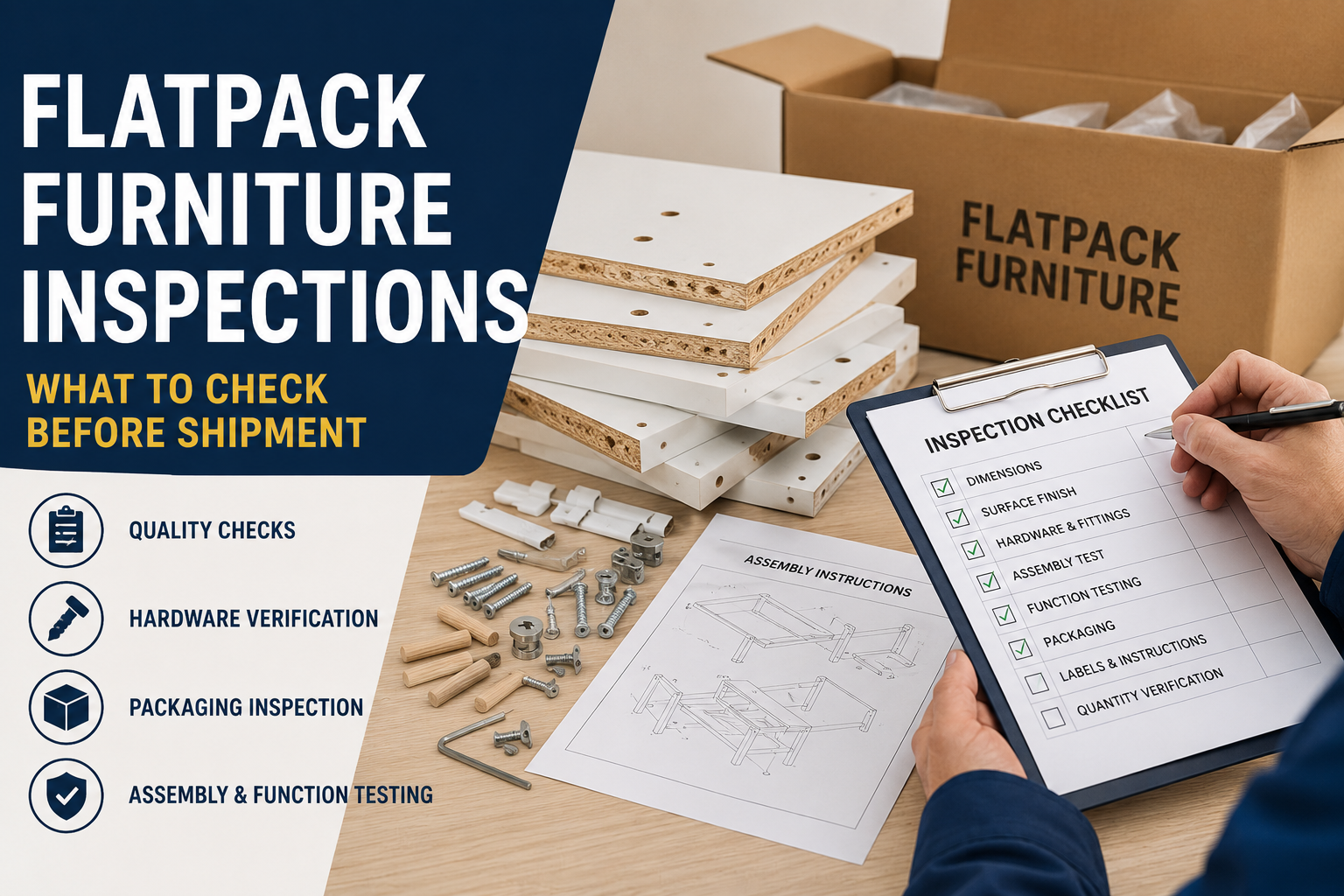
Flatpack Furniture Inspections – What to Check Before Shipment
Flatpack furniture has become one of the most important product categories in global furniture manufacturing and international trade. Its lower shipping costs, efficient container utilisation, and suitability for eCommerce have helped drive strong growth across Europe, North America, Australia, and other international retail markets.
However, flatpack furniture also presents several quality control challenges that are different from fully assembled furniture. Small dimensional issues, missing hardware, weak packaging, incorrect drilling, or damaged panels can quickly lead to customer complaints, high return rates, and expensive replacement costs.
Because flatpack products are assembled by the customer, even relatively minor production or packaging problems can create major issues once the goods reach the end user.
For importers, retailers, distributors, and eCommerce sellers, carrying out structured flatpack furniture inspections before shipment can help reduce these risks and identify problems before products leave the factory.
Why Flatpack Furniture Requires Special Inspection Attention
Flatpack furniture is highly dependent on manufacturing precision and packaging quality.
Unlike assembled furniture, where some production issues may remain hidden until use, flatpack furniture is often fully exposed during customer assembly. If holes are misaligned, fittings are missing, or components are incorrectly labelled, the customer may be unable to complete assembly.
Common flatpack furniture categories include:
- Bedroom furniture
- Wardrobes
- Office desks
- Shelving units
- Kitchen cabinets
- TV stands
- Dining furniture
- Ready-to-assemble (RTA) furniture
Many of these products are manufactured using MDF, particleboard, melamine panels, laminated board, plywood, or engineered wood products. These materials can be vulnerable to edge chipping, surface scratches, moisture swelling, delamination, weak fixing points, and transit damage.
As a result, inspections should focus not only on the furniture itself but also on packaging, hardware, assembly instructions, and carton strength.
What Should Be Checked During a Flatpack Furniture Inspection?
1. Product Dimensions and Measurements
One of the most important areas in flatpack furniture inspections is dimensional accuracy.
Inspectors should verify:
- Overall product dimensions
- Panel dimensions
- Thickness of boards and materials
- Hole positioning and spacing
- Alignment between connecting components
Even small dimensional errors can create assembly problems. Incorrect drilling positions are one of the most common issues found during flatpack furniture inspections. Misaligned holes may prevent fittings from connecting correctly or create instability once assembled.
Checking dimensions against approved technical drawings or specification sheets is essential.
2. Material and Component Verification
The correct materials should always be verified during inspection.
This may include checking:
- MDF thickness
- Particleboard quality
- Veneer finish
- Laminate consistency
- Metal frame specifications
- Hardware quality
- Glass thickness where applicable
Inspectors should also verify that components match approved samples and purchase order requirements.
For some buyers, moisture content testing may also be important, particularly for wooden components being shipped internationally.
3. Surface Finish and Appearance
Surface appearance is extremely important in furniture products.
Inspectors should check for:
- Scratches
- Dents
- Edge damage
- Colour variation
- Bubbling or blistering
- Laminate lifting
- Paint defects
- Glue marks
- Surface contamination
Lighting conditions during inspection are important. Some surface defects only become visible under strong lighting or at certain viewing angles.
For white furniture, glossy surfaces, or dark finishes, cosmetic defects can become especially visible to customers.
4. Hardware and Fittings
Missing or incorrect hardware is one of the biggest causes of customer complaints in flatpack furniture.
Inspectors should verify that all required hardware is present, including:
- Screws
- Cam locks
- Dowels
- Hinges
- Handles
- Brackets
- Allen keys
- Fasteners
- Feet or castors
Random carton opening and hardware counting is often necessary during inspection.
The quality of fittings should also be checked. Weak hardware can create structural instability or failure during assembly.
5. Assembly Testing
Assembly testing is one of the most valuable parts of a flatpack furniture inspection.
Where possible, inspectors should assemble sample units to confirm:
- Components fit correctly
- Hole alignment is accurate
- Hardware functions properly
- Instructions are understandable
- Structural stability is acceptable
Assembly testing can quickly reveal hidden production issues that may not be obvious from visual inspection alone.
Many experienced furniture buyers consider assembly testing essential for new suppliers or new product launches.
6. Stability and Function Testing
Once assembled, the furniture should be checked for stability and functionality.
This may include:
- Door alignment
- Drawer movement
- Shelf stability
- Weight-bearing checks
- Locking system operation
- Folding mechanism function
- Overall structural rigidity
Furniture that rocks, leans, or feels unstable can create both safety concerns and customer dissatisfaction.
7. Packaging Inspection
Packaging quality is critical for flatpack furniture.
Furniture products are often shipped internationally through multiple handling points including factory loading, container transport, port handling, warehousing, distribution centres, courier delivery, and final customer delivery.
Weak or poorly designed packaging can result in significant transit damage.
Inspectors should check:
- Carton strength
- Inner protection materials
- Foam protection
- Edge protectors
- Polybags
- Carton drop resistance
- Moisture protection
- Barcode and carton labelling
Flatpack furniture packaging should be strong enough to protect panels and fittings during transportation.
8. Packaging and Carton Drop Testing
For some furniture programmes, carton drop testing may also be required.
Drop testing helps evaluate whether packaging can withstand normal transport and handling conditions.
This is particularly important for eCommerce furniture, Amazon FBA furniture products, ready-to-assemble products shipped individually, and export shipments involving multiple handling stages.
Damage caused during transportation is one of the most common causes of returns in flatpack furniture.
9. Barcode, Labelling, and Instruction Checks
Incorrect labelling or missing assembly instructions can create major operational problems.
Inspectors should verify:
- Carton markings
- SKU labels
- Barcode readability
- Country of origin labels
- Warning labels
- Assembly instructions
- Multi-language documentation where required
Assembly instructions should also be checked for clarity and completeness.
Poor instructions can lead to assembly mistakes, damaged products, and customer frustration.
Flatpack Furniture Inspection Checklist Table
| Inspection Area | What Should Be Checked | Common Problems Found |
|---|---|---|
| Product Dimensions | Panel sizes, hole positions, board thickness, alignment | Incorrect drilling, poor fit, dimensional errors |
| Surface Finish | Scratches, dents, colour consistency, laminate finish | Edge chipping, bubbling, surface marks |
| Hardware and Fittings | Screws, hinges, dowels, handles, brackets | Missing hardware, weak fittings, incorrect parts |
| Assembly Testing | Product assembly, fit, stability, instruction accuracy | Misalignment, instability, assembly difficulty |
| Function Testing | Drawer movement, door alignment, shelf support | Poor movement, loose fittings, structural weakness |
| Packaging | Carton strength, foam protection, edge protection | Transit damage, crushed cartons, insufficient protection |
| Labelling and Instructions | SKU labels, barcodes, manuals, warning labels | Missing labels, unreadable barcodes, poor instructions |
| Quantity Verification | Carton count, product quantities, shipment accuracy | Short shipments, mixed cartons, incorrect quantities |
Common Defects Found in Flatpack Furniture
Some of the most common issues found during flatpack furniture inspections include:
- Incorrect drilling positions
- Missing hardware
- Edge chipping
- Surface scratches
- Incorrect panel sizes
- Poor carton protection
- Weak hinges or fittings
- Colour inconsistency
- Warped panels
- Delamination
- Assembly instability
- Missing instructions
Many of these issues are relatively inexpensive to correct at factory level but extremely expensive to resolve once products have reached retail stores or customers.
Why Pre-Shipment Inspections Are Important for Flatpack Furniture
Flatpack furniture is often shipped in high volumes across international supply chains.
Because products are packaged before shipment, many issues become difficult or impossible to identify after goods leave the factory.
Pre-shipment inspections help buyers verify:
- Product quality
- Packaging standards
- Assembly performance
- Shipment quantities
- Carton labelling
- Product consistency
They can also help reduce the risk of customer complaints, returns, marketplace penalties, retailer rejections, replacement costs, and reputation damage.
Furniture Inspection Services
Independent furniture inspections are commonly used by importers, furniture retailers, eCommerce sellers, buying offices, distributors, and furniture brands.
Goodada provides independent Furniture Quality Control Inspection Services across major manufacturing regions worldwide.
For North American buyers, additional information is also available on the Goodada Furniture Inspection Services page.
These services can include pre-shipment inspections, during production inspections, factory audits, supplier verification, and container loading inspections.
The level of inspection required will usually depend on the product complexity, order value, supplier experience, and buyer risk profile.
Additional Furniture Quality Resources
Furniture buyers and sourcing teams may also find the following Goodada resources useful:
- Furniture quality control and sourcing articles on the Goodada blog
- Furniture packaging and transit damage prevention
- Common furniture manufacturing defects
- Wooden furniture inspection guides
- Furniture supplier audit guidance
These resources can help buyers better understand common manufacturing and supply chain risks within the furniture industry.
Conclusion
So, Flatpack furniture inspections play an important role in reducing sourcing and product quality risks.
Because flatpack products depend heavily on dimensional accuracy, packaging protection, and correct assembly components, relatively small production issues can quickly become major customer problems.
Therefore structured inspections before shipment can help identify issues early and support more consistent product quality across international supply chains.
For companies sourcing furniture internationally, taking a proactive approach to inspections, packaging verification, and supplier oversight can help reduce costly issues later in the supply chain.
Frequently Asked Questions
What is checked during a flatpack furniture inspection?
A flatpack furniture inspection typically includes checks on dimensions, surface finish, hardware, assembly testing, packaging quality, labelling, and shipment quantities.
Why is assembly testing important?
Assembly testing helps identify issues such as incorrect drilling positions, missing hardware, and component fitting problems before shipment.
What are the most common flatpack furniture defects?
Common defects include scratches, edge chipping, missing fittings, incorrect dimensions, unstable assembly, and packaging damage.
Why is packaging important for flatpack furniture?
Flatpack furniture is vulnerable to transit damage. Strong packaging helps protect panels, fittings, and surfaces during shipping and handling.
Do importers use third-party furniture inspections?
Yes. Many importers and retailers use independent furniture inspections to help verify product quality and reduce supply chain risk before shipment.