
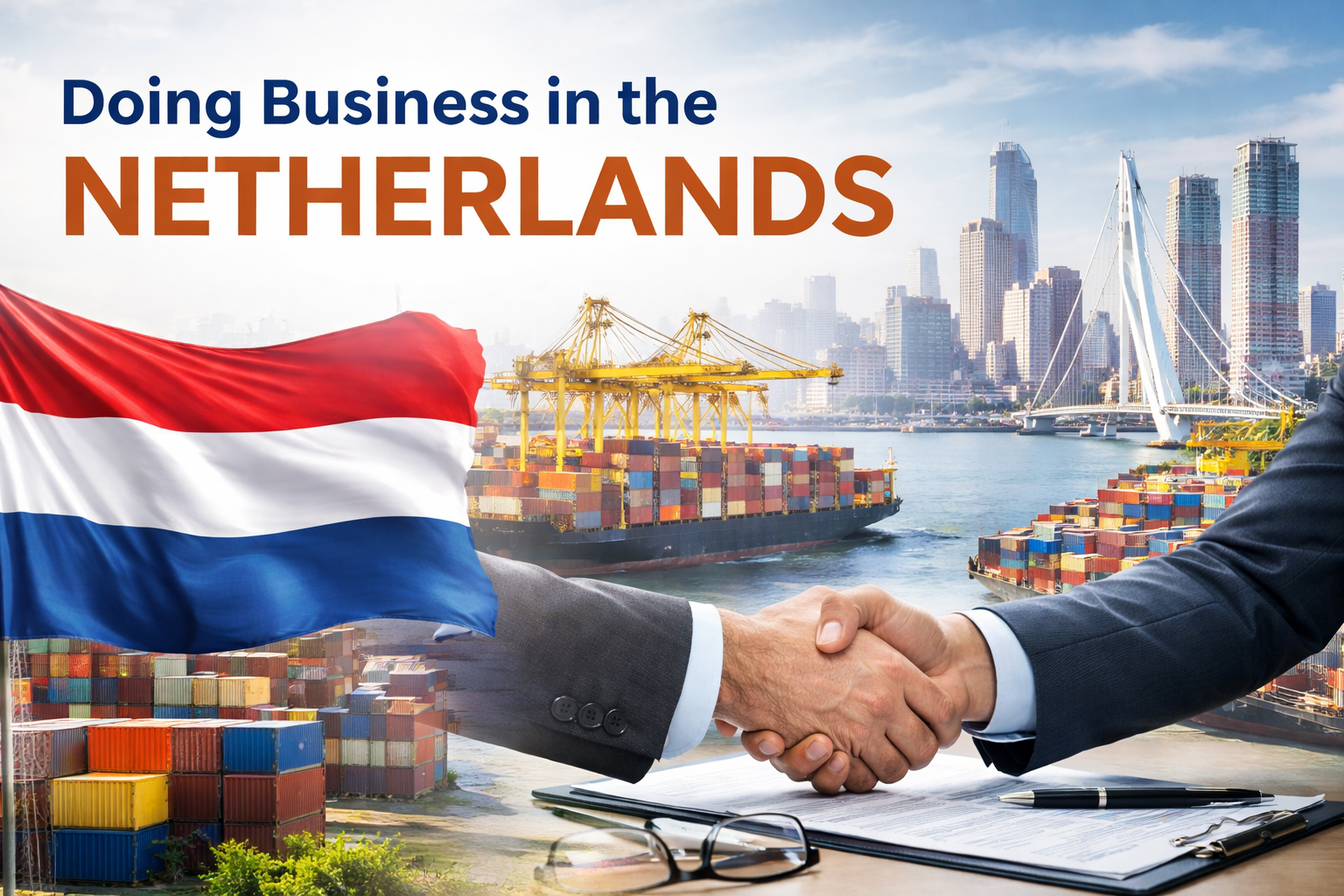
Doing Business in the Netherlands – What International Companies Should Know Before Expanding – The Netherlands is one of the most efficient trading environments in Europe. That’s a compliment. But it’s also a warning.
I’ve seen companies treat Rotterdam as just another stop on a shipping schedule. Goods land. Paperwork clears. Trucks roll out. Job done.
Except it isn’t.
If your products enter Europe through the Netherlands, that entry point becomes your most important operational checkpoint. It’s where small issues either get contained — or quietly spread across Germany, France, and Scandinavia before anyone notices.
Efficiency doesn’t eliminate risk. It accelerates it.
Dutch Business Culture – Clear, Direct, and Performance-Led
The Dutch are direct. That’s not rudeness — it’s clarity. There isn’t much appetite for ambiguity. If documentation is wrong, you’ll be told. when goods don’t match specification, you’ll see photos. If delivery slips repeatedly, you’ll feel the relationship cool.
What builds trust in the Netherlands?
- Accuracy
- Consistency
- Clear communication
- Fast correction when something goes wrong
What damages it?
- Over-explaining avoidable mistakes
- Blaming freight forwarders
- “Close enough” standards
Dutch buyers and distributors expect alignment between product, packaging, paperwork, and performance. If those align consistently, business is straightforward.
If they don’t, discussions become formal very quickly.
Setting Up in the Netherlands – Opportunity with Accountability
There are strong reasons so many companies choose the Netherlands as their European base.
Rotterdam is Europe’s largest port. Schiphol is one of its most connected air cargo hubs.
Road links into Germany and Belgium are seamless. And Customs systems are digital and efficient.
On paper, it’s ideal.
But when doing business in the Netherlands after you have established a Dutch entity, warehouse, or importer-of-record structure, the responsibility shifts. You are no longer “just exporting.” You are operating inside the EU framework.
That means:
- CE compliance becomes your responsibility.
- Labelling compliance becomes your responsibility.
- Environmental reporting becomes your responsibility.
- Product safety becomes your responsibility.
Many companies underestimate that shift. The Netherlands runs efficiently — but it does not operate casually.
Trading with the Netherlands – Tariffs vs. Real-World Barriers
Because the Netherlands applies the EU Common External Tariff, duty rates are generally predictable. Correct HS code. Right origin. Correct preference claim. That part is manageable.
The real disruption when doing business in the Netherlands usually comes from non-tariff barriers. In practice, friction arises from:
- Incorrect CE marking
- Missing technical documentation
- Packaging that doesn’t meet EU environmental requirements
- Labelling gaps
- REACH compliance issues
- Phytosanitary inconsistencies for food imports
Here’s what catches companies out:
A container can clear Rotterdam customs at 10:00am and still be rejected by a buyer that afternoon.
Never forget this – “Customs checks paperwork. Buyers check reality”.
I’ve seen CE marks applied correctly — but no technical file available when requested. I’ve seen packaging compliant in origin markets but missing mandatory EU importer details.
Customs clearance is administrative. Market acceptance is commercial.
They are not the same thing.
Rotterdam and Schiphol – Speed Changes the Stakes
Rotterdam moves at scale. Schiphol handles high-value cargo at pace. Both are efficient. But speed magnifies oversight gaps.
Once cargo is discharged:
- Storage charges begin immediately.
- 3PL handling starts quickly.
- Redistribution schedules are already locked in.
If a quantity discrepancy or visible transit issue isn’t identified immediately, goods may already be moving toward Germany before anyone notices. At that stage, it’s no longer a Dutch problem. It becomes a multi-country problem.
This is why experienced operators often implement structured quality control checks on arrival in the Netherlands when shipments will be redistributed across the EU.
It’s not about adding friction. It’s about containing risk early.
3PL Handling and Transit Reality
Pre-shipment inspections at origin are useful. They establish a baseline. However, containers travel, Pallets shift, Humidity fluctuates. Warehouses re-stack.
One of the most common issues I see isn’t manufacturing defects. It’s handling. Retail cartons compressed under heavier loads. Pallets slightly misaligned during cross-docking. Labels catching during redistribution.
None of these existed at origin. All of them become commercial conversations on arrival.
Many businesses now carry out inbound cargo inspections at Dutch entry points to confirm shipment condition before onward distribution. Identifying issues here is simpler than negotiating across borders later.
Fresh Produce – Small Deviations, Large Consequences
The Netherlands is one of Europe’s largest fresh produce hubs. Fruit from Latin America, Africa, and Southern Europe moves through Rotterdam daily. In perishable trade, hours matter.
Temperature fluctuations of even a couple of days can alter grade classification. That difference can remove margin instantly.
I’ve seen consignments where only part of the shipment was compromised. When identified early in the Netherlands, sorting and segregation preserved commercial value. When identified late, it became a claim file. That’s not theory. That’s arithmetic.
Local quality control sorting in the Netherlands can sometimes mean the difference between partial recovery and total write-off.
Disputes – Structure and Evidence Matter
Most trade disputes aren’t dramatic. They’re procedural.
9,980 units loaded.
9,940 counted.
A pallet corner slightly crushed. Cosmetic scuffing on retail cartons.
The Dutch approach disputes logically. Evidence wins. If condition at arrival is documented clearly, conversations are shorter. If it isn’t, discussions stretch. And stretched discussions cost money.
Documented confirmation at EU entry simplifies:
- Carrier claims
- Supplier accountability
- Internal reporting
- Insurance negotiations
Clarity reduces escalation.
The Mistakes I See Repeatedly
Certain patterns repeat.
“It cleared customs, so we’re fine.”
No — customs clearance isn’t commercial acceptance.
“We inspected at origin.”
Transit introduces new variables.
“It’s just passing through the Netherlands.”
That “just” is often where EU-wide friction begins.
Waiting too long to verify shipment condition is consistently the most expensive decision.
The Netherlands rewards structured operators and exposes loose systems quickly.
When Structured Oversight Makes Sense
Not every shipment needs the same attention. But additional oversight in the Netherlands typically makes sense when:
- Goods are high value.
- Distribution spans multiple EU countries.
- Retail timelines are fixed.
- Products are fragile.
- Fresh produce is involved.
- European expansion is scaling rapidly.
For companies distributing through Rotterdam or Schiphol, structured Netherlands quality control inspections and local sorting capability can significantly reduce downstream disputes. That’s not bureaucracy. That’s commercial control.
Doing Business in the Netherlands – Final Perspective
The Netherlands isn’t difficult. It’s disciplined.
It rewards companies that operate with structure and exposes those that rely on assumption.
Treat it as a waypoint and problems compound. Treat it as your European control hub and expansion becomes predictable. If Europe matters to your business, your Netherlands strategy should be deliberate — not reactive.
That shift alone changes outcomes. If, after reading this blog, you require support services in the Netherlands, please don’t hesitate to contact me. My details are below:
Contact Person: Aidan Conaty (Goodada Customer Support)
Mobile- Messenger (Click to Connect)

Laptop / PC (Click to Connect)

Phone:(Europe/ Rest of the World) +353 1 885 3919 ; (UK) +44.020.3287.2990 ; (North America) +1.518.290.6604