

Often modern supply-chain planning has become increasingly sophisticated. Businesses invest heavily in ERP platforms, forecasting systems, inventory optimisation, supplier portals and artificial intelligence. These systems can process enormous amounts of information and model scenarios that would have been difficult to manage only a few years ago.
But there is a more basic question:
How reliable is the information being fed into the plan?
A planning system may accurately calculate inventory requirements, forecast when stock will be needed and determine when purchase orders should arrive.
But if the supplier information supporting those calculations does not reflect what is actually happening at the factory, the apparent precision of the plan can become misleading.
A sophisticated supply plan built on unreliable information is still an unreliable supply plan.
The challenge is therefore not simply to create a better plan. It is to improve the quality, timing and reliability of the information used to make planning decisions.
For more than two decades, Goodada Inspections has supported international buyers through quality inspections, supplier verification, factory audits and production monitoring. That experience repeatedly shows that quality, production, supplier communication, logistics and commercial planning are closely connected.
The purpose of independent verification is therefore not simply to identify defects. It can also give management better information about what is actually happening within the supply chain.
Executive Summary
Supply planning depends not only on forecasting accuracy but also on the reliability of information coming from suppliers.
Production delays, material shortages and quality problems become much more difficult and expensive to manage when buyers discover them late.
Three principles are particularly important:
- Supplier-reported progress should not automatically be treated as verified production progress.
- The earlier a supply problem becomes visible, the more options management retains.
- Production and quality information should feed back into future supplier and planning decisions.
This does not mean independently verifying every order.
A better approach is to identify which assumptions within the supply plan would have the greatest commercial consequences if they proved incorrect, and then decide where additional verification is justified.
Where the Supply Plan Meets Factory Reality
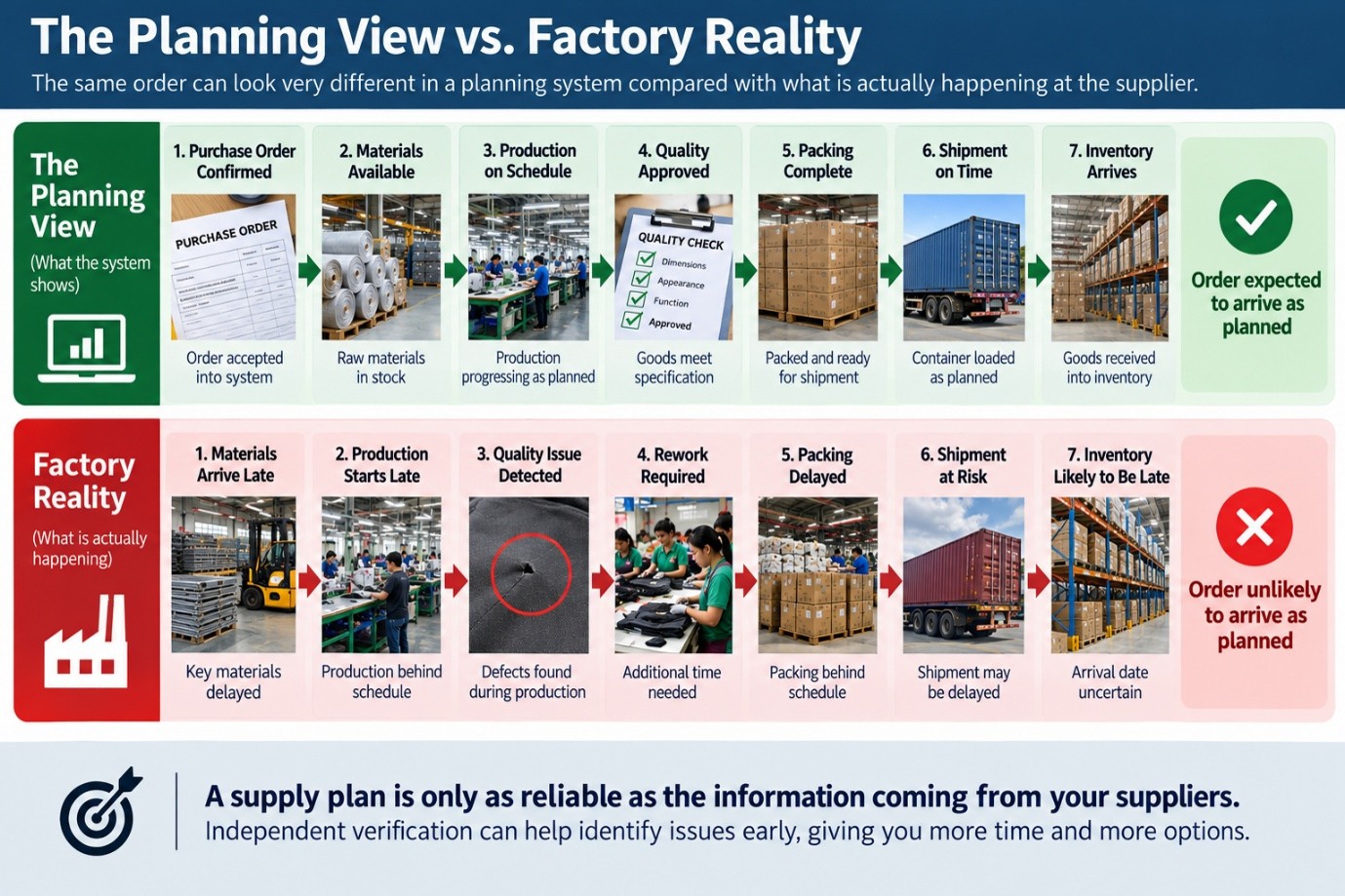
Most supply plans eventually depend on events taking place outside the buyer’s direct control.
A supplier confirms raw materials are available.
Production is scheduled.
A completion date is agreed.
Quality control follows.
The goods are packed.
Shipment is booked.
Each event becomes an assumption supporting the next stage:
Purchase Order → Materials → Production → Quality Approval → Packing → Shipment → Inventory
The difficulty is that factories rarely operate as neatly as planning systems.
Raw materials can arrive late. Production lines can be reassigned. Equipment can fail. Workers can be moved to another order. Rework may be required. A subcontractor may fall behind.
Production can even be described as “complete” while a significant quantity is still waiting for quality approval or packing.
These situations do not automatically mean that a supplier is badly managed. They are part of manufacturing.
The important management question is:
When will the buyer know that factory reality has moved away from the supply plan?
Graphic 1 — The Planning View vs Factory Reality
Supplier Information and Operational Evidence Are Not the Same Thing
Inaccurate production information does not always mean that a supplier is deliberately providing incorrect information.
A sales team may itself be working from outdated production data.
A production manager may believe lost time can be recovered before shipment and therefore see little reason to escalate a temporary delay.
Different departments may also define production progress differently.
For example, a supplier might report:
“The order is approximately 80% complete and remains on schedule.”
That statement may be genuine.
But what does 80% actually mean?
A more useful operational picture might be:
- 10,000 units ordered
- 8,100 manufactured
- 7,300 through internal quality control
- 6,900 accepted
- 5,800 packed
- Components for the remaining 1,900 units due in four days
Both descriptions could refer to the same order.
But the second gives management considerably more useful information.
It allows the business to assess whether the completion date remains realistic, whether the unfinished quantity creates a risk and whether contingency action may be required.
This leads to a useful management principle:
The greater the consequence of an assumption being wrong, the stronger the evidence management should consider requiring to support it.
The Cost of Discovering the Truth Too Late
Case Example: Six Weeks of Reassurance, but Production Had Not Started
A Swedish buyer was sourcing decorative tumble-dryer balls from a supplier in Nepal.
The products were intended for sale through Amazon, and timing was important because stock needed to be available for the Black Friday sales period.
For approximately six weeks, the buyer believed production was progressing towards completion.
As the commercial deadline approached, Goodada was asked to independently establish the actual production position.
When the inspector arrived, the physical situation was very different.
Raw materials had only recently arrived and production had not started.
The most important consequence was not simply that the order was late.
“Six weeks of potential decision-making time had disappeared.”
To protect the sales opportunity, the buyer subsequently had to use air freight rather than the originally planned logistics arrangements.
There was also insufficient time for planned barcode work to be completed at the factory, so barcode attachment had to be arranged separately at the destination warehouse.
The problem became more expensive because the buyer discovered it late.
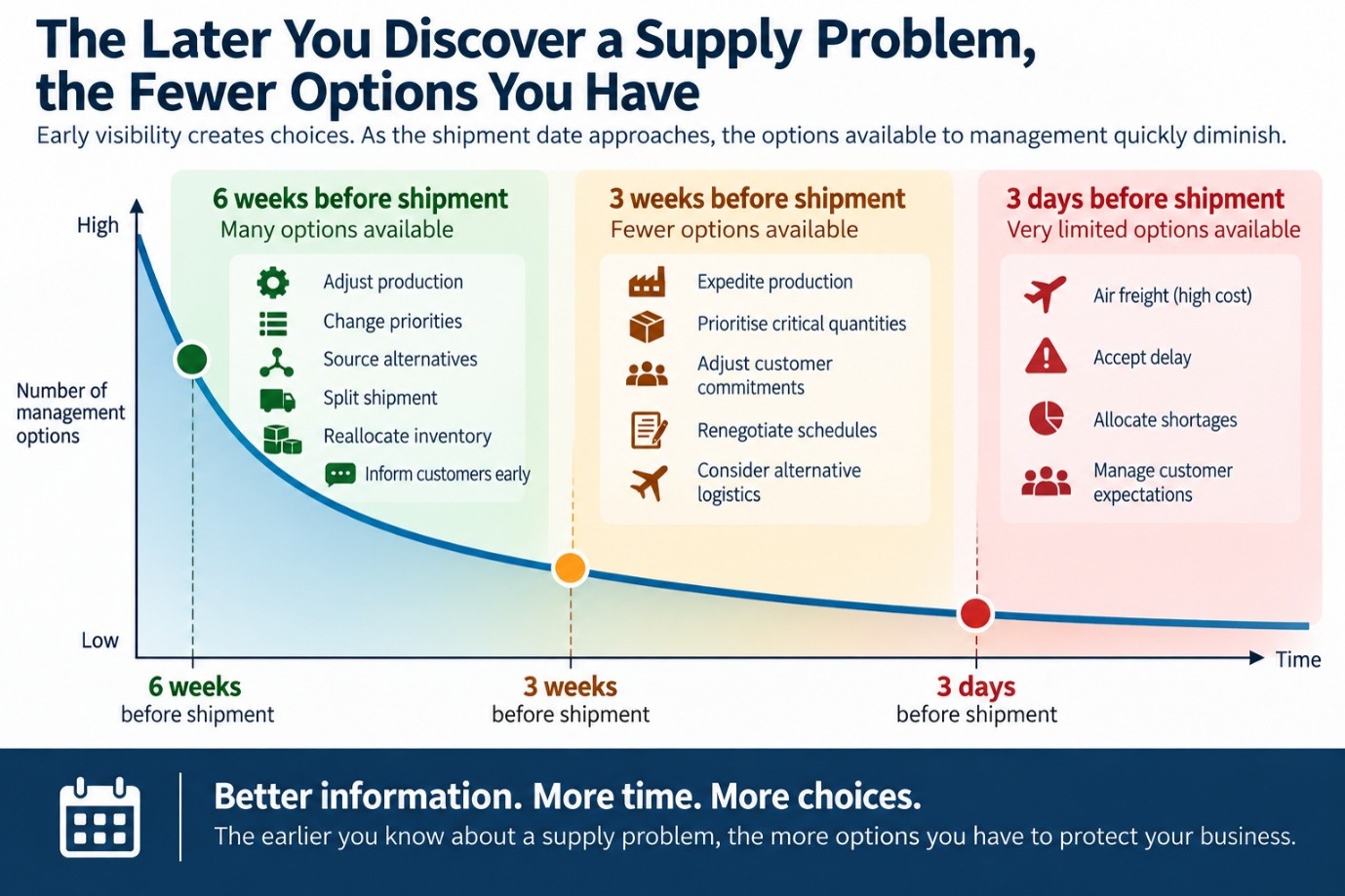
Earlier Visibility Creates More Options
Time is one of the most valuable resources available when managing a supply problem.
Discovering a likely delay six weeks before shipment may allow management to:
- Change production priorities
- Split an order
- Approve alternative materials
- Reallocate available inventory
- Change logistics arrangements
- Move production to another line or supplier
- Inform customers earlier
- Adjust promotional activity
- Protect priority markets
Discovering the same problem three days before shipment removes many of those choices.
The management question should therefore not only be:
“Do we have a supply problem?”
It should also be:
“How early will we know that we have a supply problem?”
Earlier information can directly affect freight costs, inventory availability, customer commitments, working capital and profitability.
Graphic 2 — The Later You Discover a Supply Problem, the Fewer Options You Have
Quality Problems Are Also Supply-Planning Problems
Organisations often separate procurement, quality, planning and logistics.
Operationally, however, these functions are connected.
Suppose a factory produces 20,000 units and an inspection identifies a recurring workmanship problem.
For the quality team, the question may be whether the goods meet specification.
For management and planning, the questions become wider:
- How many saleable units will actually be available?
- How long will rework take?
- Will shipment still leave on time?
- Does inventory need to be reallocated?
- Will customers be affected?
- Will additional sorting or inspection be required?
- Should logistics arrangements change?
A quality problem can quickly become a production, inventory, logistics and customer-service problem.
Case Example: When a Quality Problem Became a Four-Month Supply Problem
A UK buyer had ordered approximately 45,500 BBQs and smokers from a manufacturer in China for distribution across several markets.
Goodada carried out a pre-shipment inspection after production.
During the inspection, an enamel scratch test found that the black exterior coating could be removed relatively easily.
Further assessment identified inconsistent coating thickness across the products. Some areas had received a thinner coating and were more vulnerable to scratching and coating loss.
Corrective work and the resulting disruption delayed the programme by approximately four months.
The delay also caused the buyer to miss an important summer sales season in Australia.
The inspection prevented the affected products from entering distribution.
But the broader management issue was timing:
“By the time the systemic problem was identified, approximately 45,500 units had already been produced.”
That raises a different question.
It is not enough to ask whether quality control can identify a problem.
Businesses should also ask:
“At what stage is a serious production or quality problem likely to become visible, and will management still have enough time to respond?”
The Timing of Verification Matters
The Nepal and China cases demonstrate different versions of the same problem.
In Nepal, independent verification established that production had not started when the buyer believed the order was considerably further advanced.
In China, the pre-shipment inspection successfully identified a serious quality problem before shipment, but only after tens of thousands of units had already been produced.
The lesson is not simply to inspect suppliers.
It is to: Verify the right information at the right stage.
For some orders, a pre-shipment inspection may provide an appropriate level of control.
For higher-risk orders, waiting until production is complete may leave management with few options if a serious problem is discovered.
Building Verification Into Supply Planning
This does not mean independently inspecting every order or distrusting every supplier statement.
That would be expensive and unnecessary.
A more practical approach is risk-based.
Management can identify the assumptions with the greatest potential impact on the business and decide which justify independent verification.
Factors may include:
- Strategic importance of the product
- Supplier performance history
- Order value and volume
- Product complexity
- Previous quality problems
- Length of the replenishment cycle
- Difficulty of replacing the supplier
- Consequences of late delivery
- Existing inventory levels
- Seasonal sales windows
- Importance to key customers
A long-established supplier producing a routine product with a consistent history may require relatively little intervention.
A new supplier producing a technically complex product with a long lead time, limited safety stock and a fixed seasonal sales window represents a very different risk profile.
The objective is not maximum inspection.
It is: Appropriate visibility at the appropriate time.
Independent Verification as Management Information
This is where quality control can become part of a broader management-support process.
The objective is not simply to determine whether goods pass or fail.
It is also to give management reliable information about what is happening within the supply chain early enough to make informed decisions.
Supplier audits, production monitoring and quality inspections can provide independent operational information.
A production visit may help establish:
- Actual quantities produced
- Production stages reached
- Raw-material availability
- Quality trends
- Rework levels
- Packing progress
- Production constraints
- Whether factory conditions match the supplier’s reported status
A supplier audit can help management understand capacity, equipment, workforce, quality systems, subcontracting and production controls before assumptions about that supplier become embedded in future planning.
A pre-shipment inspection provides independent information about finished goods before shipment.
The appropriate approach depends on risk.
The management question becomes:
“Which assumptions in our supply plan are important enough that we should independently verify them?”
Turn Inspection Data Into Better Supplier Data
Inspection and production information should not disappear into individual reports after an order ships.
Over time, businesses can compare what suppliers promised against what actually happened.
Management can ask:
- Does a supplier regularly underestimate production time?
- Are promised completion dates reliable?
- Do recurring quality problems appear at particular production stages?
- Is additional time routinely required between production completion and shipment readiness?
- How closely do supplier commitments match actual results?
This information can improve future planning assumptions.
For example:
A supplier may quote a 30-day lead time.
Historical performance may show that its actual average time to shipment is 37 days.
Continuing to plan around 30 days because that is the contractual lead time creates unnecessary risk.
Using actual performance produces a more realistic planning assumption.
In this way: Yesterday’s inspection and production information can become tomorrow’s planning intelligence.
Graphic 3 — Supplier Information Feedback Loop
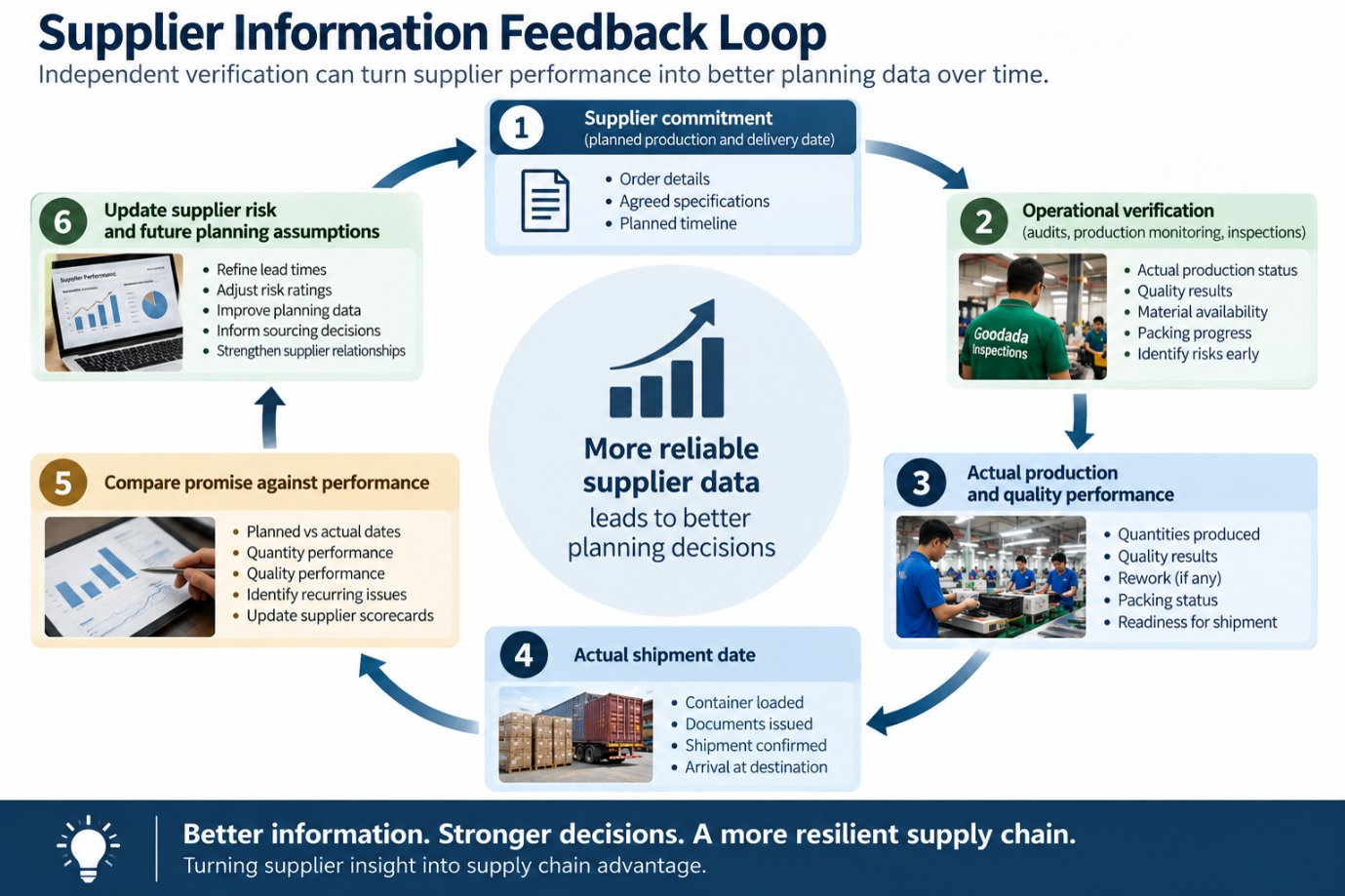
The process is simple:
Supplier Commitment → Independent Verification → Actual Performance → Measurement → Updated Planning Assumption
The Goodada Supplier Information Reliability Scorecard
Not every supplier requires the same level of oversight.
The challenge is determining where additional verification adds value and where supplier information can reasonably be relied upon.
It is useful to distinguish between supplier performance and information reliability.
A supplier may manufacture an excellent product but provide poor visibility of production progress.
Another supplier may occasionally experience delays but communicate them early and accurately, giving the buyer sufficient time to respond.
For supply planning, both matter.
The Goodada Supplier Information Reliability Scorecard assesses ten areas:
| Assessment Area | Management Question |
|---|---|
| Production status accuracy | Does reported production progress match what is actually happening? |
| Delivery date reliability | How closely do confirmed dates match actual completion and shipment? |
| Early warning of delays | Does the supplier communicate problems before they affect delivery? |
| Evidence supporting progress | Are updates supported by quantities, dates, photographs or other evidence? |
| Raw-material visibility | Does the supplier provide clear information about shortages and availability? |
| Quality transparency | Are quality problems and corrective actions communicated early? |
| Production capacity reliability | Does actual capacity support commitments being made? |
| Subcontracting transparency | Does the buyer know where and when work is subcontracted? |
| Packing and shipment readiness | Does “ready” genuinely mean produced, approved and packed? |
| Promise versus actual performance | How closely do previous commitments match actual outcomes? |
Each area can be scored from 1 to 5, producing a maximum score of 50.
The purpose is not to classify a supplier simply as good or bad.
It is to answer a more useful question:
How much confidence should management place in the information this supplier provides when making planning decisions?
Suggested interpretation
| Score | Information Confidence | Management Approach |
|---|---|---|
| 41–50 | Higher confidence | Routine monitoring may be sufficient, subject to order risk. |
| 31–40 | Reasonable confidence | Consider verifying important milestones on higher-risk orders. |
| 21–30 | Limited confidence | Consider regular verification of production status and critical milestones. |
| 10–20 | Low confidence | Earlier and stronger independent oversight should be considered. |
A high score does not mean product inspections or supplier due diligence are unnecessary.
The score measures confidence in supplier information used for planning. It does not measure overall supplier capability or product quality.
Download the Goodada Supplier Information Reliability Scorecard
The Excel version can be used to score suppliers and compare supplier commitments with actual performance.
Measure the Supplier Confidence Gap
The scorecard becomes more useful when supported by historical data.
Instead of relying only on judgement, businesses can record the difference between what suppliers said would happen and what actually happened.
For example:
1. Lead-Time Confidence Gap
Supplier promise: Production completed in 30 days
Actual: Production completed in 38 days
Confidence gap: +8 days
2. Production-Status Confidence Gap
Supplier reported: 80% complete
Independent verification: 52% complete
Confidence gap: -28 percentage points
3. Shipment-Readiness Confidence Gap
Supplier reported ready: 12 June
Actually ready: 19 June
Confidence gap: +7 days
One difference may have a reasonable explanation.
Repeated differences are more useful.
Over six or twelve months, management can identify whether a supplier consistently overestimates progress, underestimates lead times or provides optimistic shipment dates.
Future planning can then reflect what actually happens rather than relying only on contractual promises.
Five Questions Management Should Ask
Businesses reviewing their supply-planning processes should consider five questions:
1. Which important parts of our supply plan depend entirely on information from suppliers?
Identify assumptions that would create the greatest commercial consequences if incorrect.
2. How do we verify critical milestones on higher-risk orders?
Verification should reflect commercial risk rather than applying the same process to every order.
3. How early would we know if an important supplier was unlikely to meet its commitment?
Knowing a shipment will be late is useful.
Knowing six weeks earlier may be considerably more valuable.
4. Does production and quality information reach procurement, inventory and planning teams?
Quality information should not remain within the quality department when it affects available quantities or delivery dates.
5. Do we compare supplier promises with actual outcomes?
Without comparing commitments with results, businesses may repeatedly build future plans around assumptions that historical evidence has already shown to be unreliable.
Better Information Before Better Planning
Better forecasting systems, software and artificial intelligence can improve supply planning.
But greater mathematical sophistication cannot compensate indefinitely for unreliable information about what is physically happening within the supply base.
The objective is not to create a perfect supply plan.
It is to give management reliable information early enough to make better decisions.
For more than two decades, Goodada Inspections has worked with buyers, importers and supply-chain organisations across international manufacturing markets.
Through supplier audits, production monitoring and quality inspections, Goodada helps businesses independently establish what is happening within their supply chains.
- Sometimes production is less advanced than expected.
- Very often a quality problem has consequences far beyond the quality department.
- Sometimes supplier information is accurate but reaches management too late to be useful.
- And sometimes the most expensive part of a supplier problem is not the problem itself, but how late the buyer discovers it.
Goodada’s role is therefore not limited to finding defects.
Independent inspection and verification can provide management with the operational information needed to understand risk earlier, challenge assumptions and make better-informed commercial decisions.
Closing that information gap is not simply a quality-control activity.
It is part of building a more informed, resilient and responsive supply chain.
Better supplier information does not guarantee a perfect plan. It gives management something more valuable: more time, more choices and a better basis for making decisions.
FAQ
What is supplier information reliability?
Supplier information reliability measures how closely the production, completion and shipment information provided by a supplier matches what actually happens.
Why is supplier information important for supply planning?
Supply plans depend on assumptions about production, materials, quality and shipment dates. If supplier information is inaccurate or provided too late, inventory, logistics and delivery plans can become unreliable.
How can businesses verify supplier production progress?
Businesses can use production monitoring, factory visits, supplier audits and quality inspections to independently confirm production status, quantities and critical milestones.
When should production progress be independently verified?
Independent verification is most valuable on higher-risk orders where production delays, quality problems or incorrect supplier information could have significant commercial consequences.